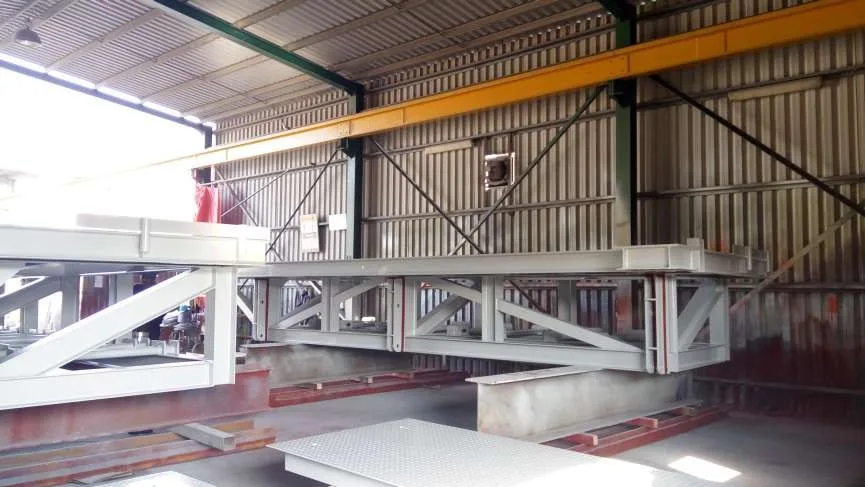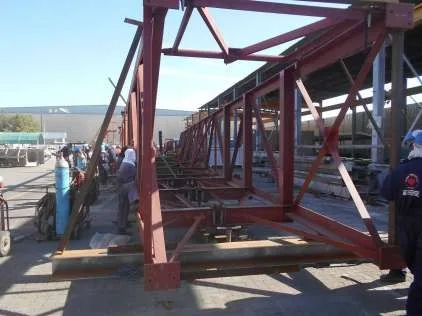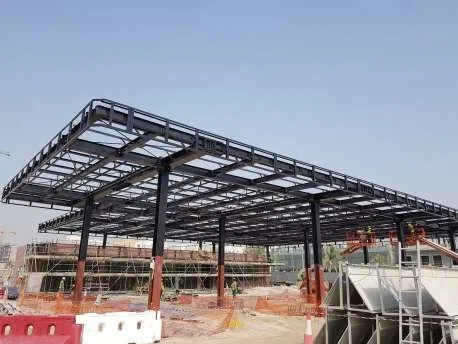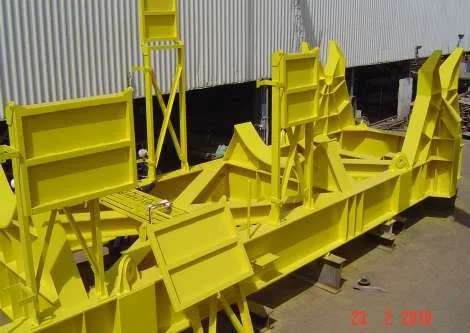
If you skim through our project list, you will notice the same four words showing up again and again: fabrication, supply, blasting and painting. We write it that way because coating is not a cosmetic afterthought bolted onto the end of a job. When you leave surface prep until the last week, that is almost always when good steelwork ends up with premature rust or a missed delivery date.
How the sequence actually runs
- Cutting, fit-up and welding to the approved drawings.
- Visual weld checks, dimensional inspection and any NDT — always on bare steel.
- Grinding off sharp edges, weld spatter and rough corners so paint has a decent edge to hold onto.
- Abrasive blasting to the specified cleanliness grade and surface profile.
- Applying the primer, intermediate and topcoats with dry-film thickness checks along the way.
- Final stencilling, data plates, wrapping and sign-off.
Doing every weld and dimensional check before the steel ever enters the blast bay saves huge headaches. Once three coats of marine epoxy are on, finding a missing bracket or a weld repair means grinding back finished paint and re-doing the whole patch.
Matching the paint system to where the steel will live
Most oilfield and industrial specs call up familiar standards — Sa 2½ blast cleanliness under ISO 8501-1 and a multi-coat system matched to the environment under ISO 12944. A lifting frame riding on an offshore supply boat in salt spray obviously needs a very different build-up from a roof purlin sitting inside an air-conditioned warehouse.
When a client does not have a written paint spec, the first thing we ask is where the steel will sit and how long it needs to go before maintenance. That tells us far more than the colour chart ever will.
What changes when it happens in-house
We run an automatic sandblasting line and two airless spray systems inside our own yard. As soon as an assembly passes inspection, our crane moves it straight across to blasting and straight on to priming. Nothing gets loaded onto a flatbed to sit overnight in Gulf humidity at an outside paint shop waiting for a booth slot.
That cuts out flash rusting between blasting and priming, avoids transport scratches, and means there is only one team accountable if anything needs touching up. Just as importantly, the delivery schedule stays under one roof.